01
Start once
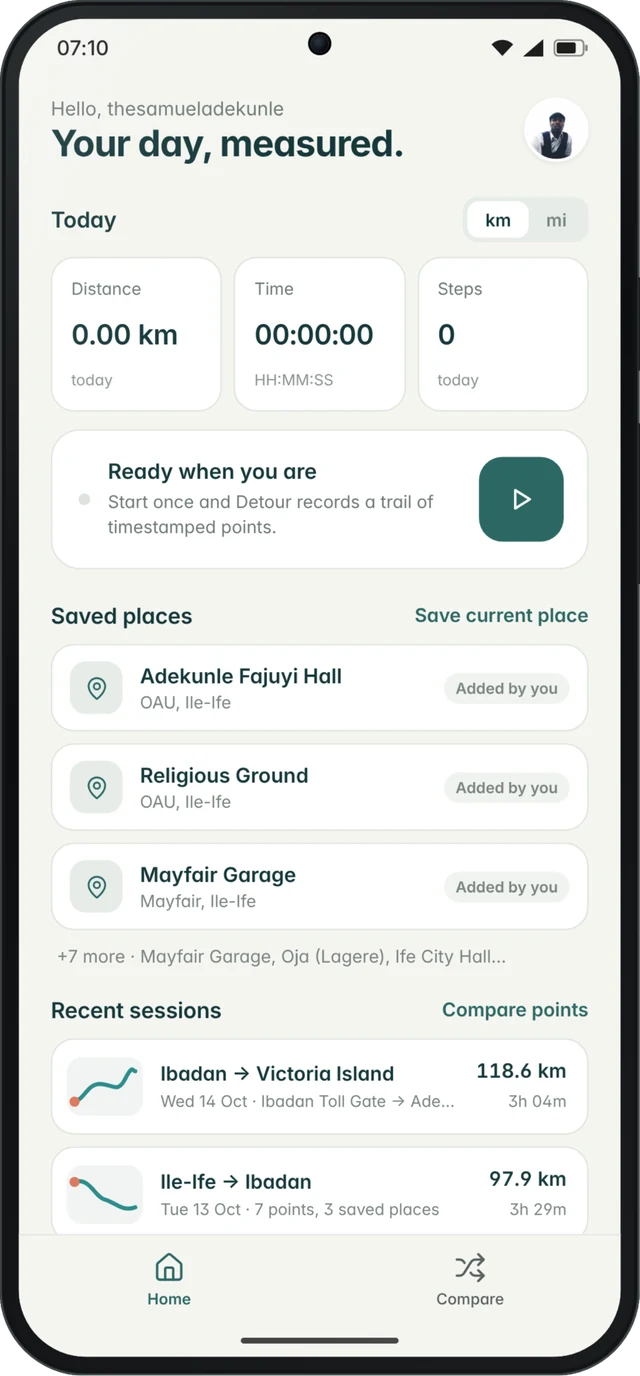
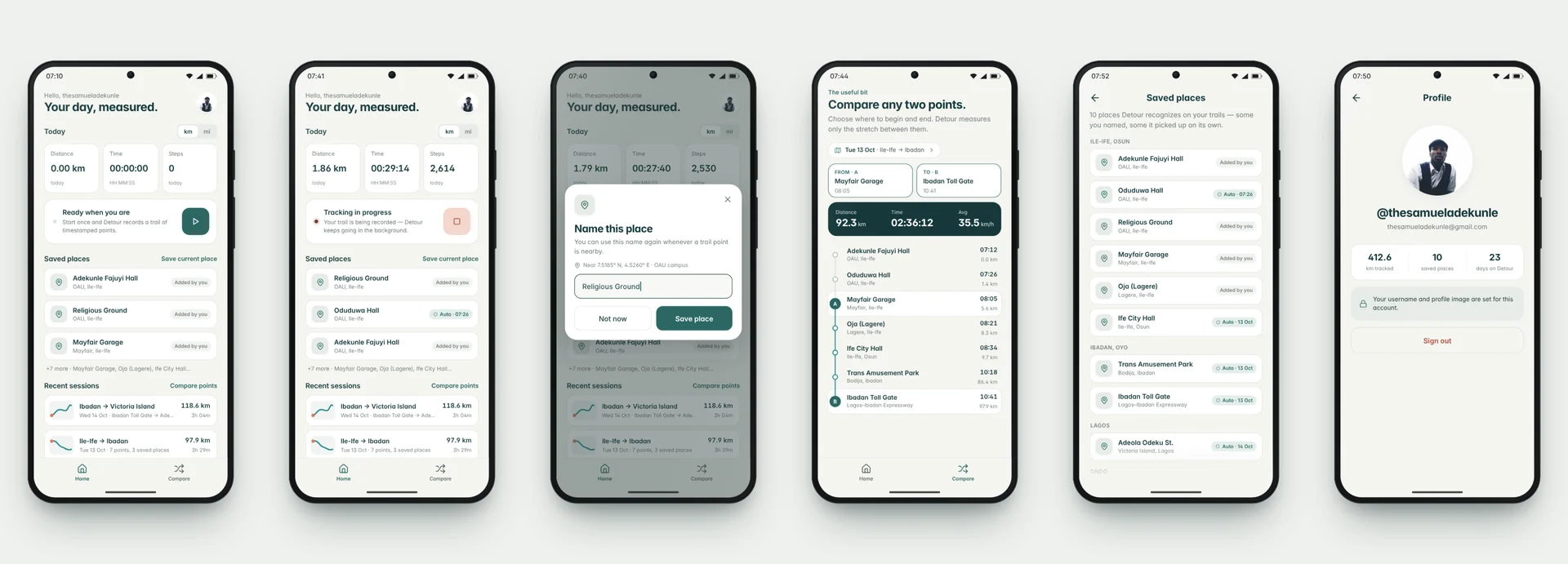
One tap starts a trail of timestamped points. Closing the app doesn't stop it; only an explicit stop does. Today's distance, time and steps update live.
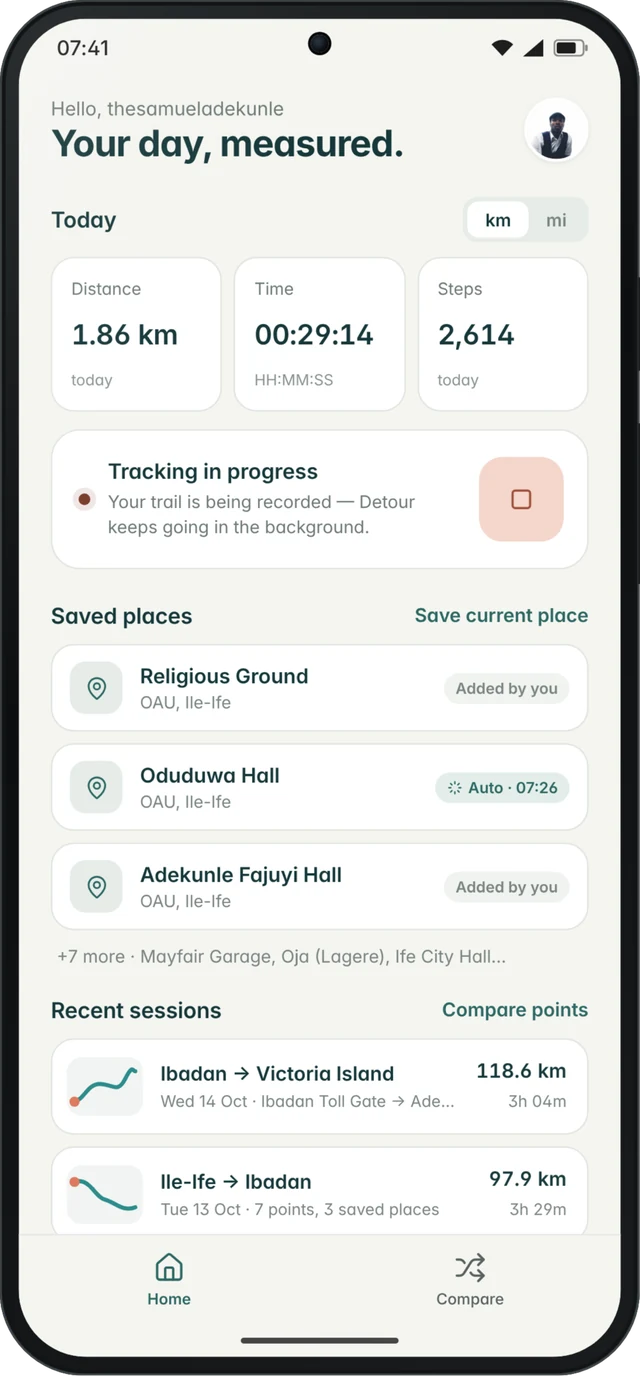
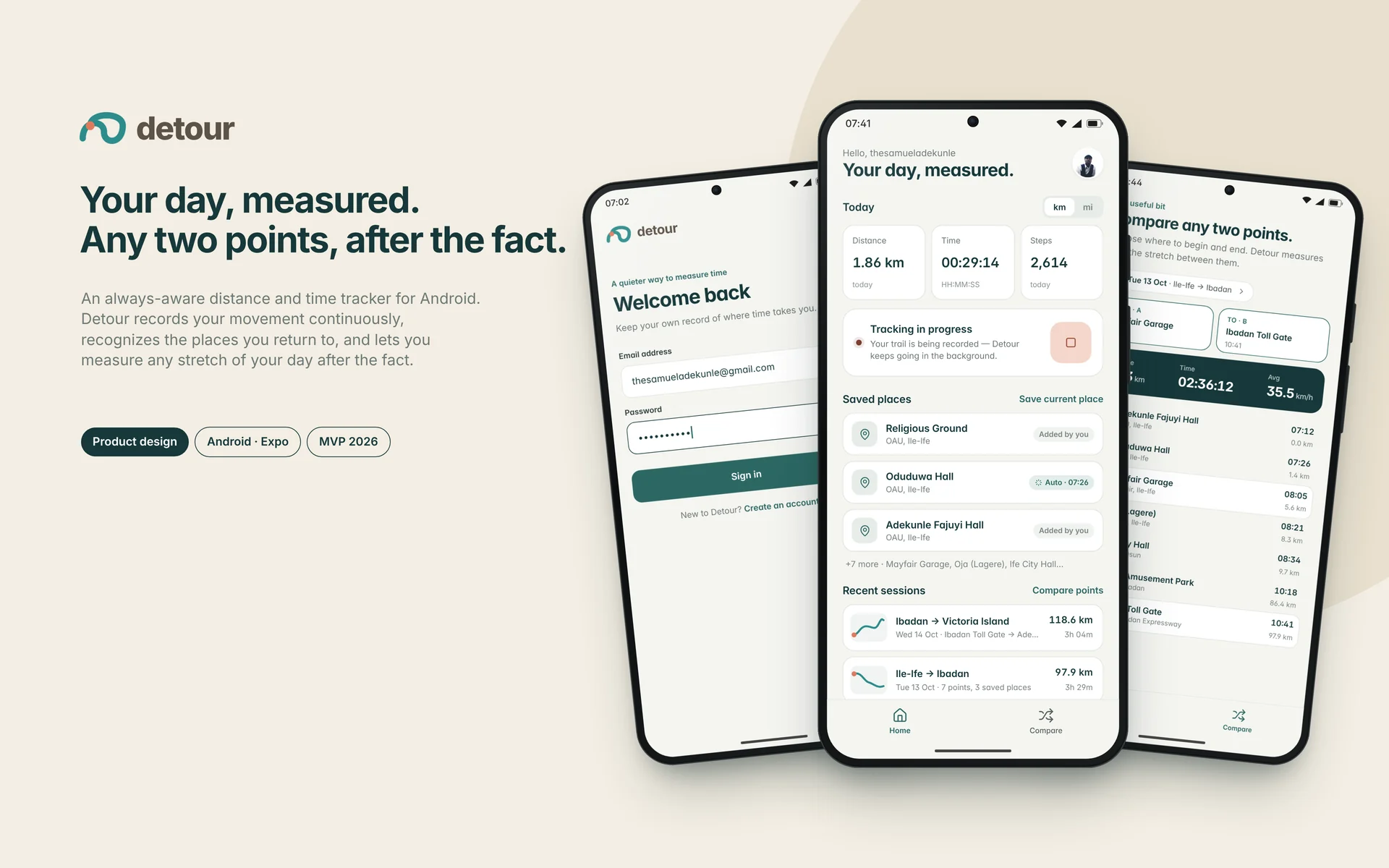
An always-aware distance and time tracker for Android. Detour records your movement in the background, recognises the places you return to, and lets you measure any stretch of your day after the fact. There's no start button to remember and no lost trips.
Strava, Huawei Health and every other tracker I used asked for the same thing: open the app, tap start, move, tap stop. When I forgot the first tap, or didn't think of a trip as an "activity", that movement was simply gone.
Session-based trackers fail in two predictable ways:
…you have to recognise, in the moment, that a trip is worth measuring, then remember to stop it when you arrive.
You can review "today's run", but you can't ask how long the stretch from the garage to the toll gate actually took.
One tap starts a trail of timestamped points. Closing the app doesn't stop it; only an explicit stop does. Today's distance, time and steps update live.
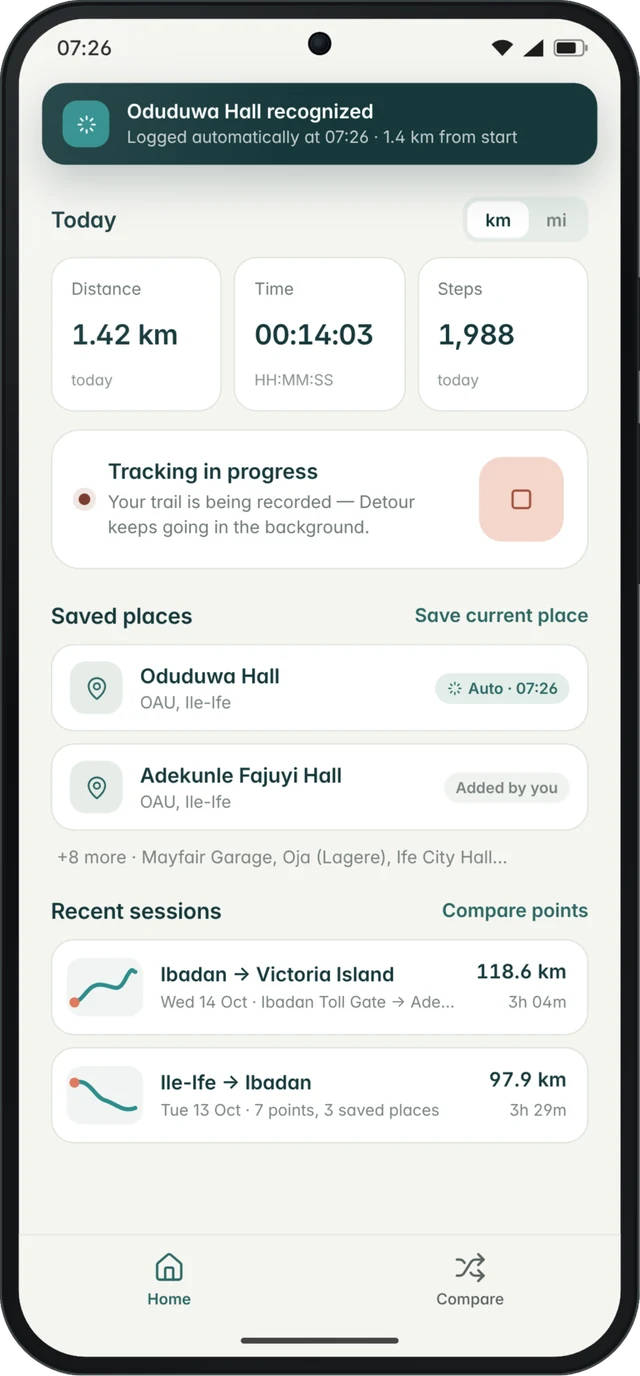
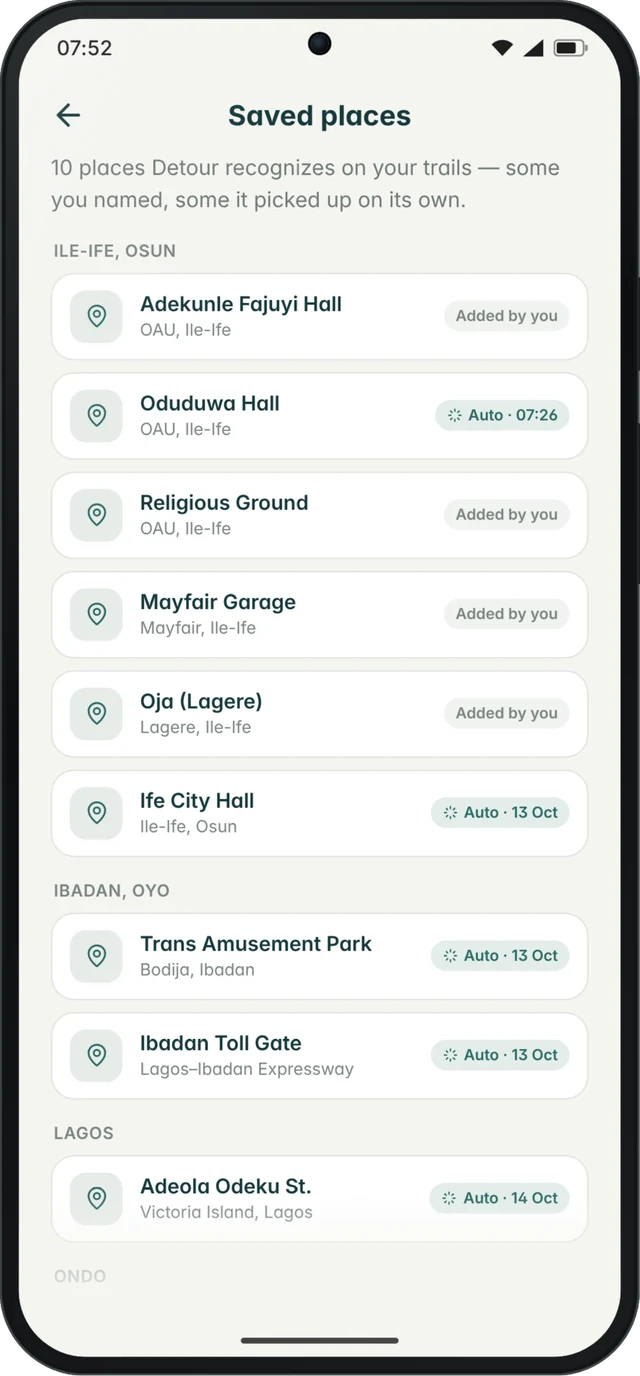
When the trail passes a place you've saved, Detour recognises it and logs the time. "Oduduwa Hall recognised, 07:26."
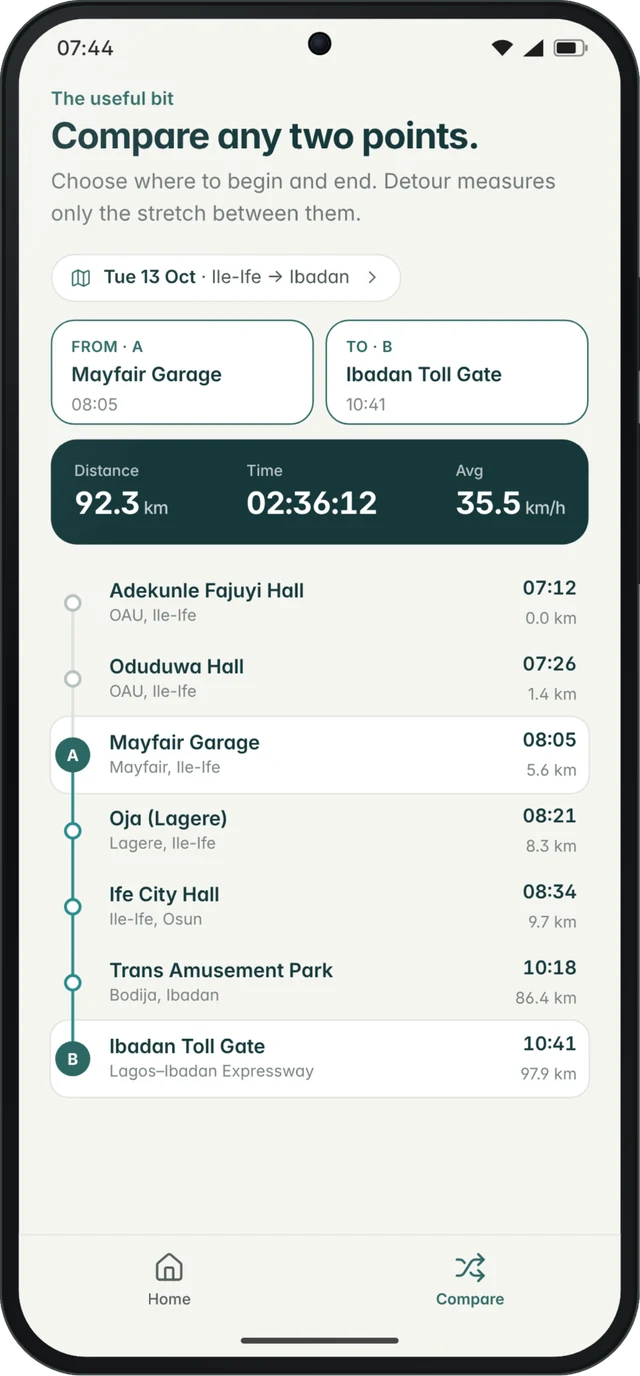
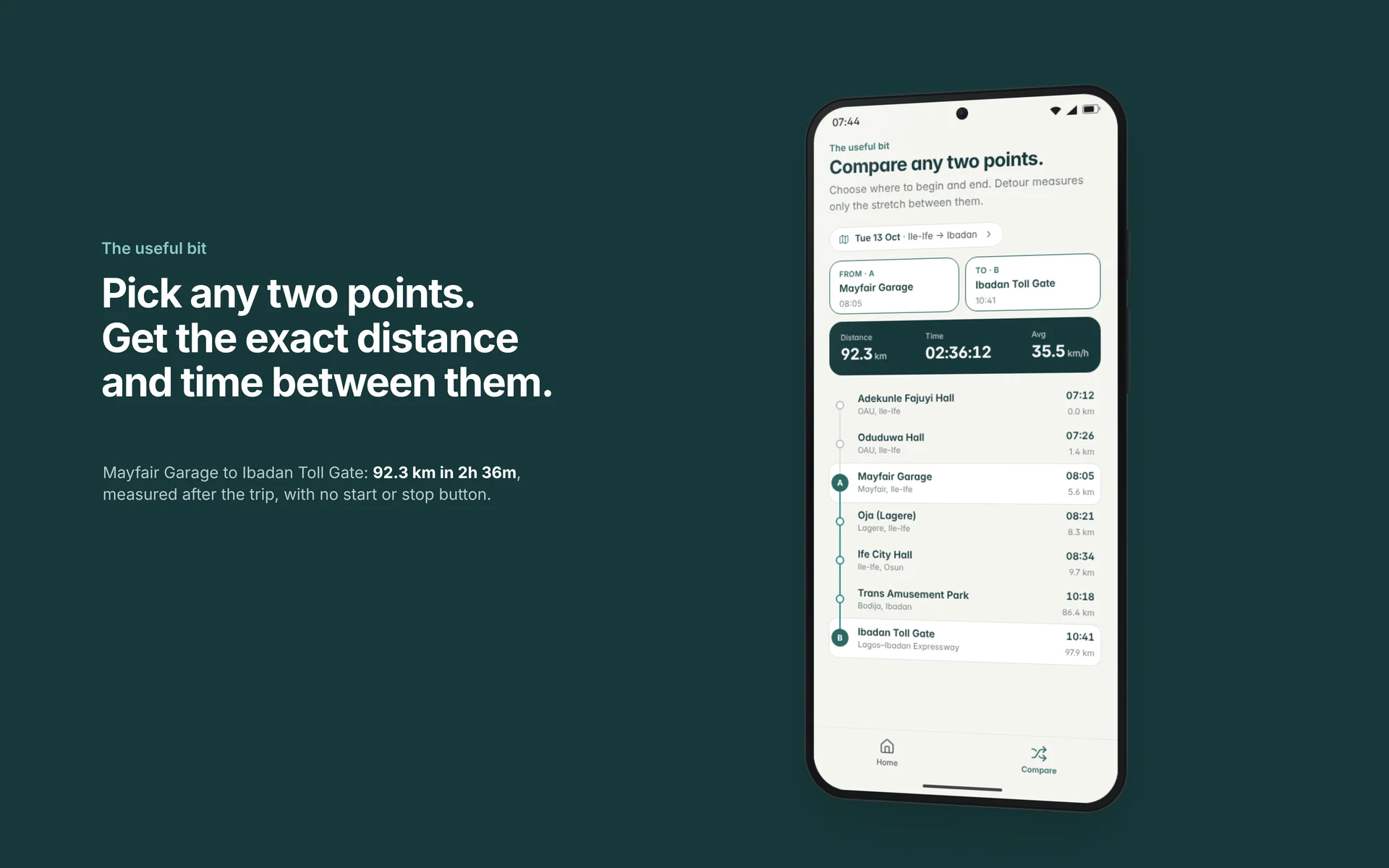
Pick a start and an end from the trail. Detour measures only the stretch between them: distance, time and average speed.
Detour isn't a better fitness app. It changes the order of the steps. The day becomes one queryable timeline instead of a pile of separate, manually bookended workouts.
Miss the first step and nothing is recorded.
Every trip is captured, including the ones you didn't plan to measure.
Example query from a Tuesday drive from Ile-Ife to Ibadan, answered after the trip was over.
Choose any two points on a trail and get the distance, time and average speed between them. This is the feature the whole product is built around.
Tracking keeps recording when the app is closed. Only an explicit stop ends it.
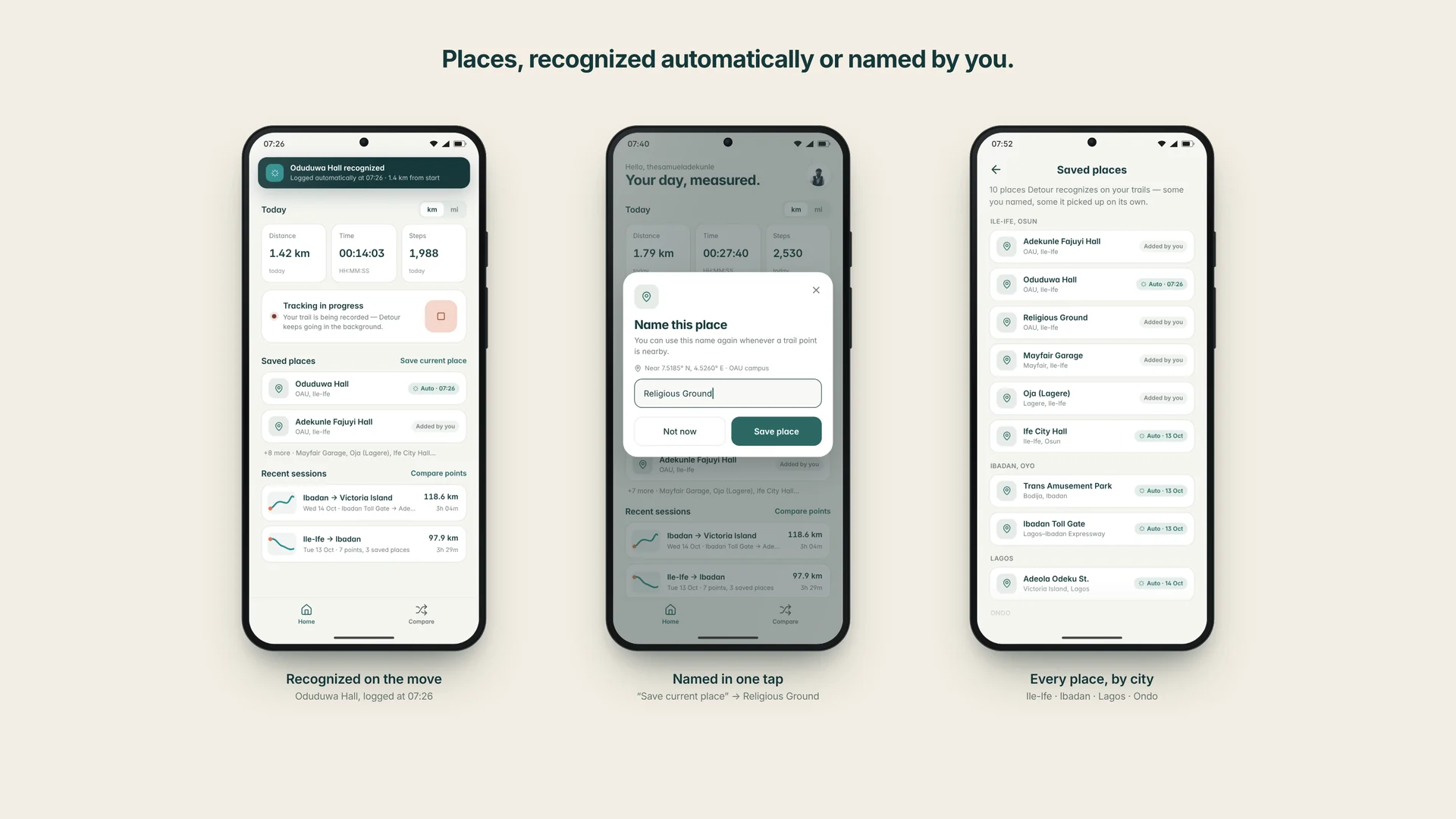
Saved places are matched whenever a trail point is nearby, so the timeline reads "Oduduwa Hall", not coordinates.
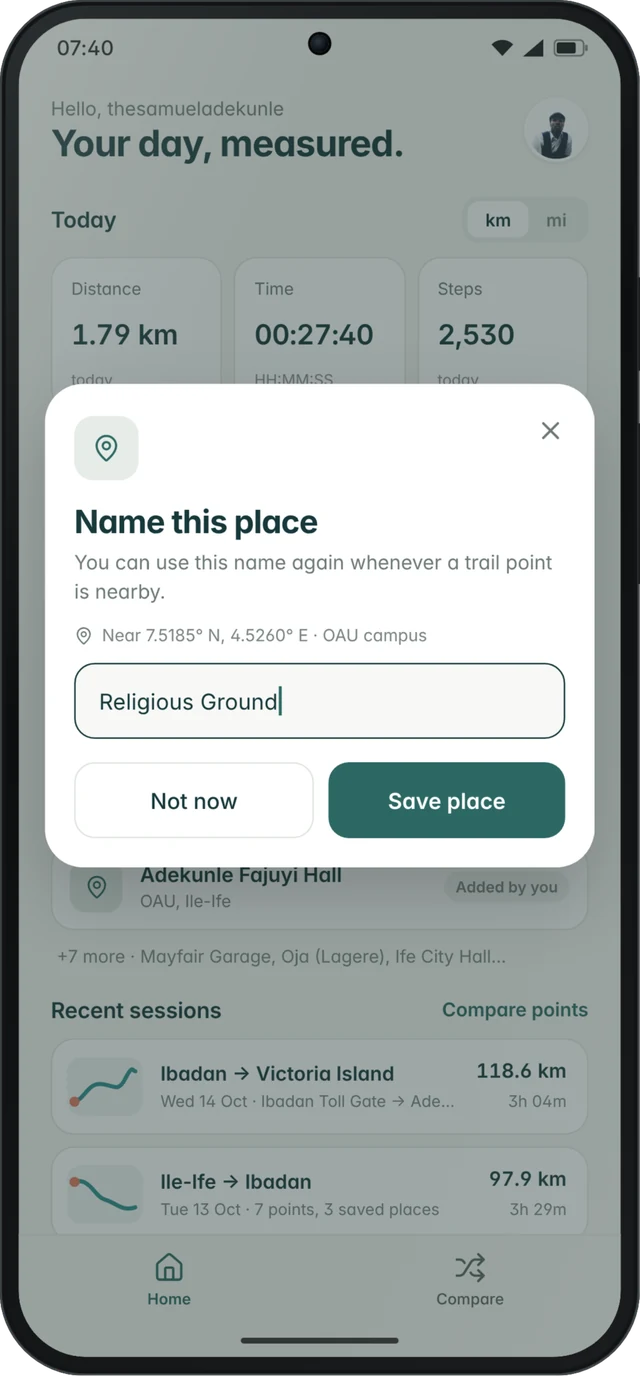
One tap opens "Name this place". Type "Religious Ground", save, and Detour remembers it from then on.
Distance, time and steps for today sit at the top of Home and update as you move.
A single toggle switches every distance in the app.
Each completed trail is kept with its total distance and duration, ready to compare later.
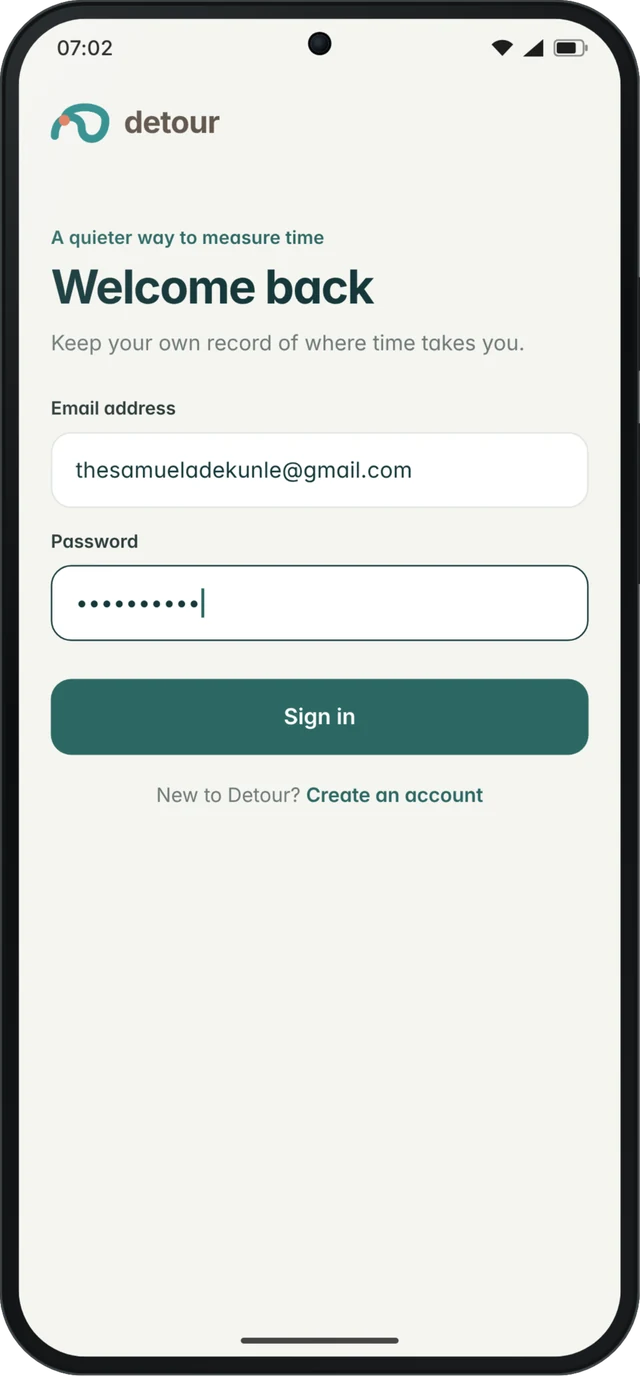
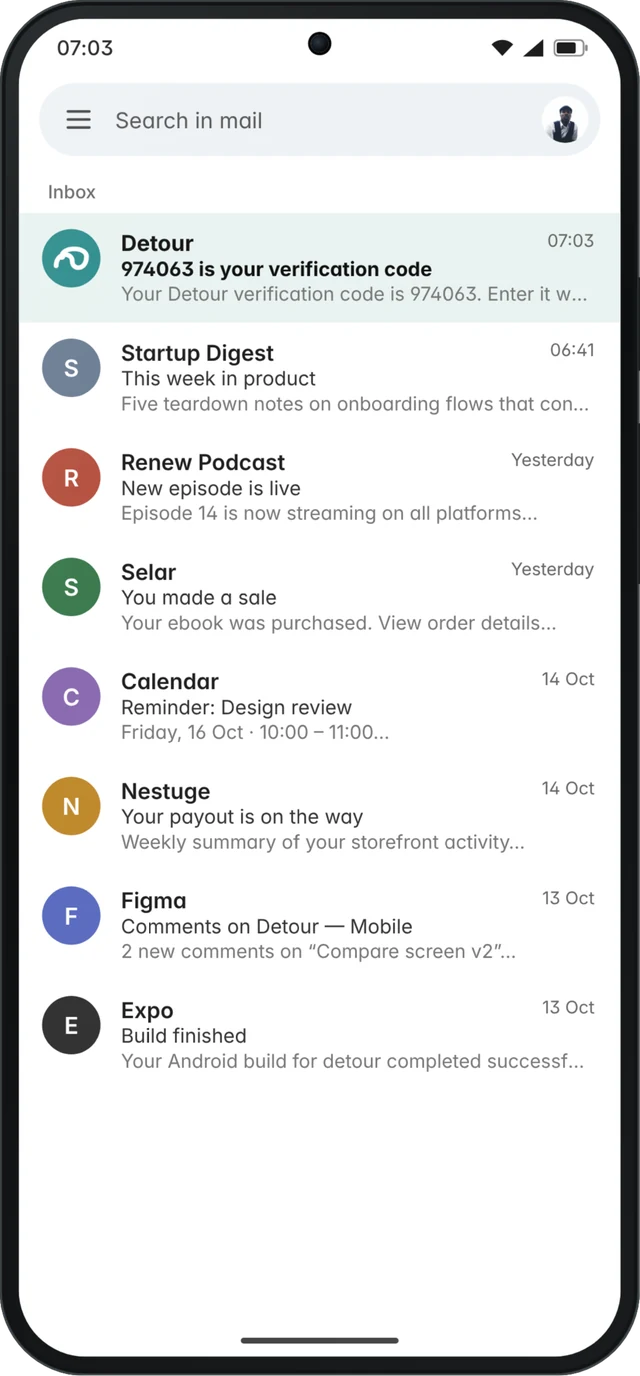
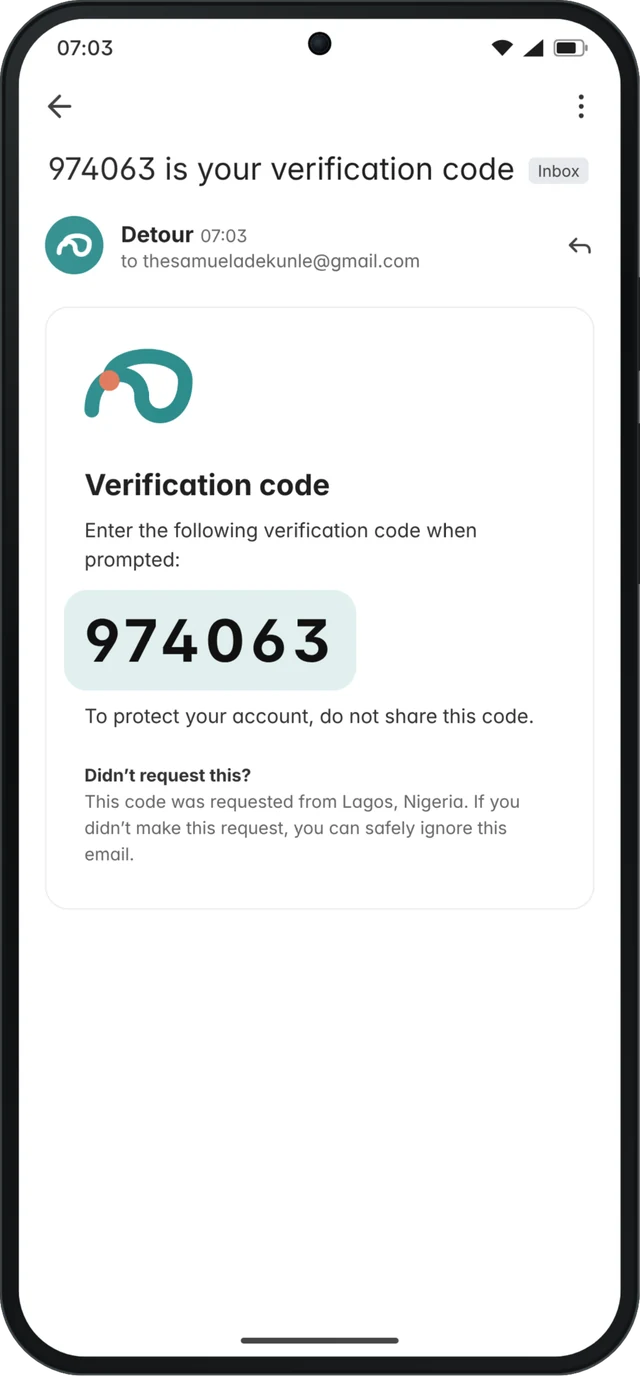
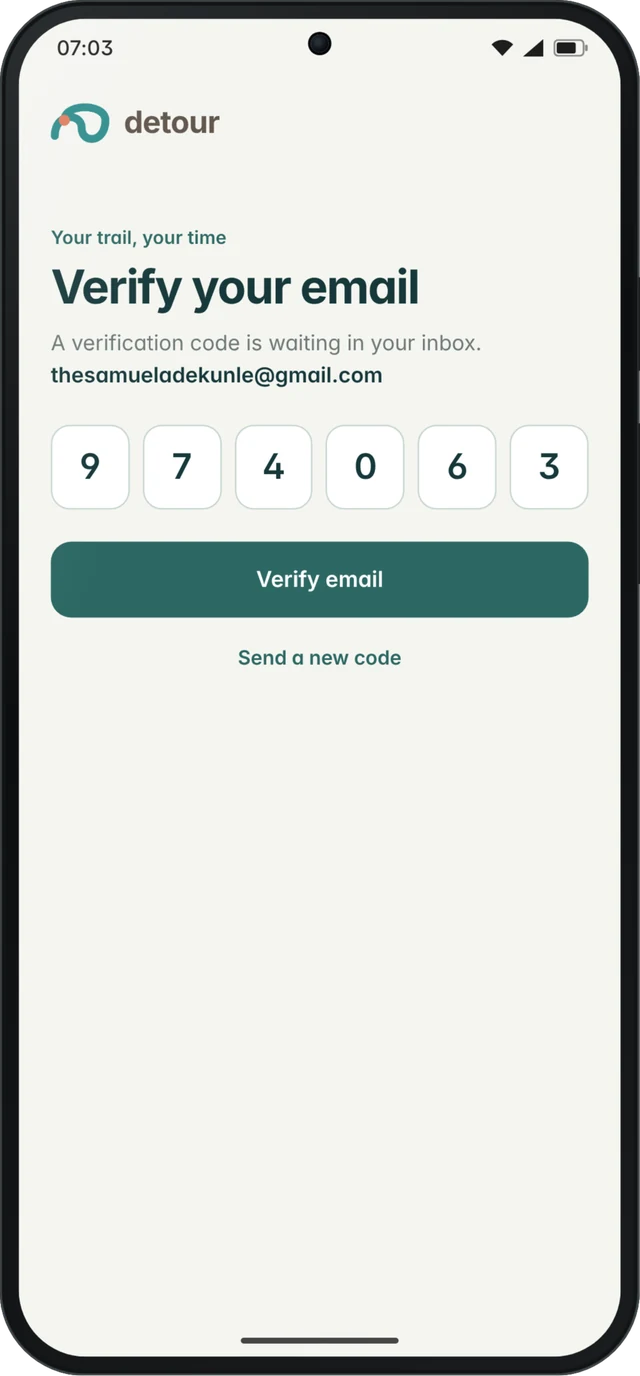
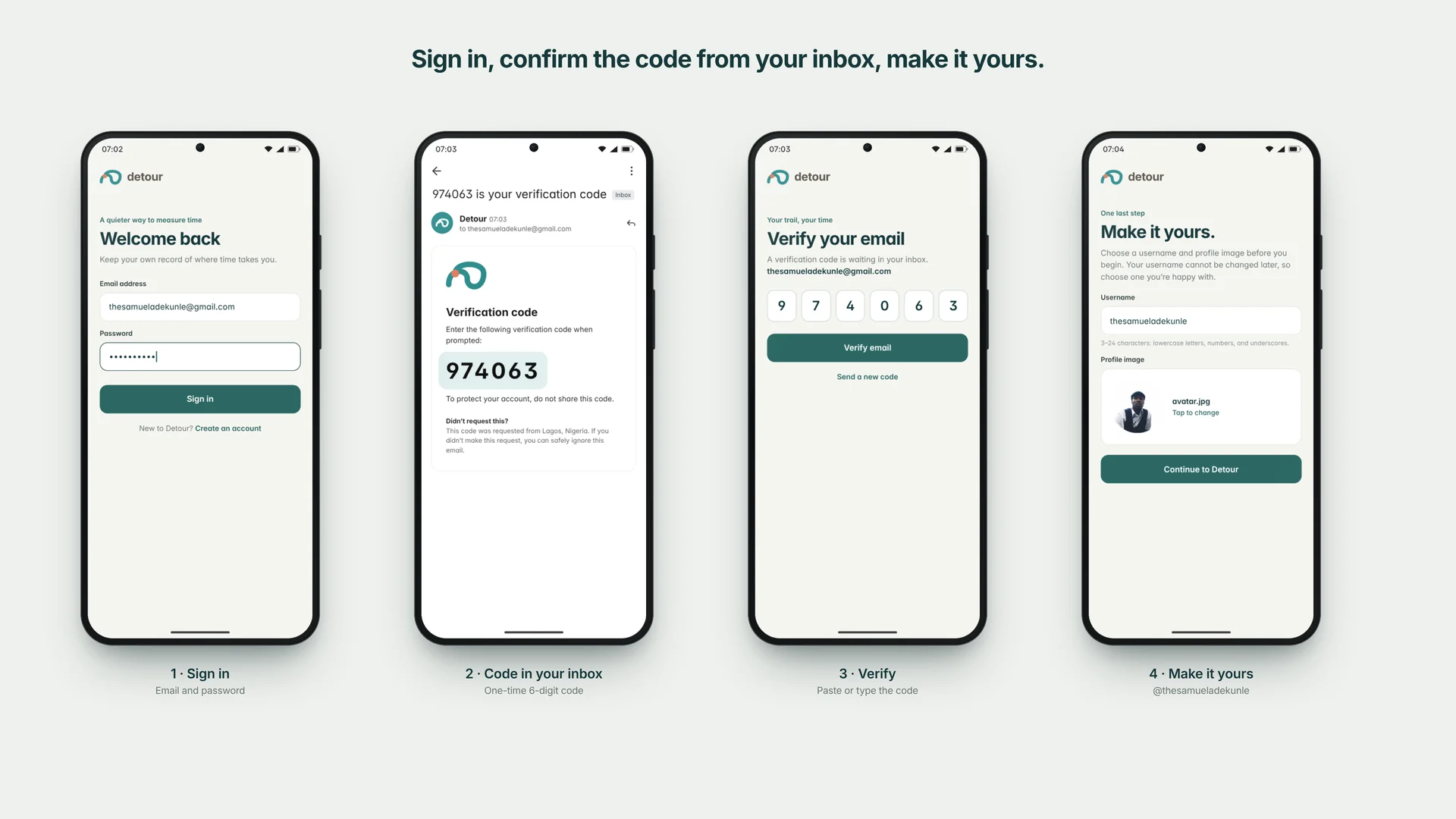
Sign in with email, confirm a six-digit code from your inbox, and you're in.
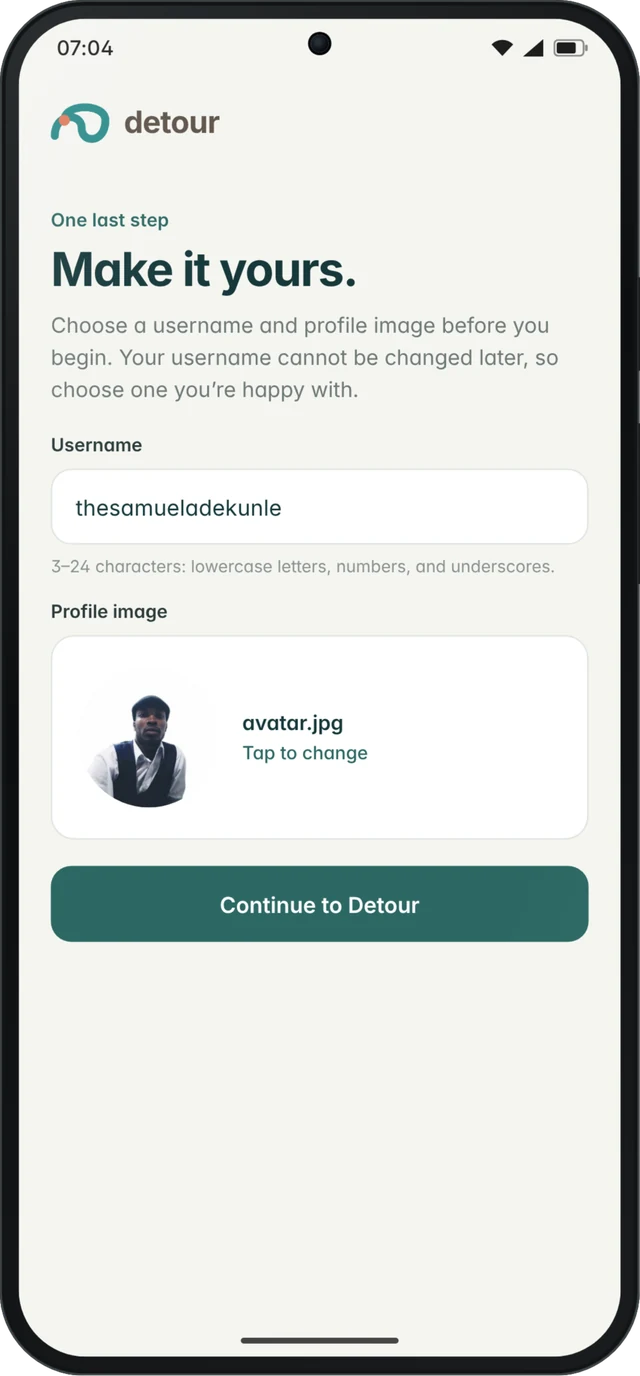
Choose a username and profile photo once. The username is locked, and the app says so before you commit.
I tested Detour on my own Android phone while moving around campus, across Ile-Ife, and on the road to Ibadan and Lagos. These are the places on my trail, some named by hand and some picked up automatically.
Fitness dashboards compete for attention with charts, badges and streaks. Detour takes its cue from calm, geometric puzzle games like Infinity Loop. You should understand your day at a glance and get on with it.
Named the gap in session-based trackers: movement you don't deliberately start is lost, and data can't be queried across a day.
Wrote the concept note and app brief. That meant two tracking modes (always-on and daily), a 24-hour view, point-to-point queries and unit choice. I was explicit that Detour is not a fitness app.
Documented Android background-location permissions, battery use, and storing and querying a continuous trail. Settled on Android first, testing through Expo links and APKs before any store listing.
Built the email-code sign-in, the Make it yours profile step, live tracking on Home, saved places with Name this place, and the Compare tab.
Ran Detour on my own phone around OAU, Ile-Ife, Ibadan, Lagos and Ondo, and fixed issues as they surfaced, including profile image uploads on native.
Designed the trail mark, rebuilt every screen as clean Android mockups, cut a 15-second showreel and wrote this case study.
A single looping path with a coral point on it: a route, and one moment on that route. It's the product's whole idea in one line. Wherever you went, Detour can tell you how far and how long it took.
Detour shows how I work: I find a real, specific frustration, reduce it to one clear idea, and carry that idea through strategy, interface, language and brand to something people can hold in their hand. It's the same instinct I bring to executive systems and event operations: capture what happens, then make it easy to ask the right question.
Next: a map view of each day's trail, multi-day queries, sharing a single A-to-B segment, battery-aware all-day tracking, and iOS.
Whether it's a frustration you keep running into, a note on your phone or a product idea on paper, I can take it from concept to a designed, working app: problem framing, product brief, UX/UI and a buildable prototype.